
Virtual Reality in Education: Transforming the Way Students Learn
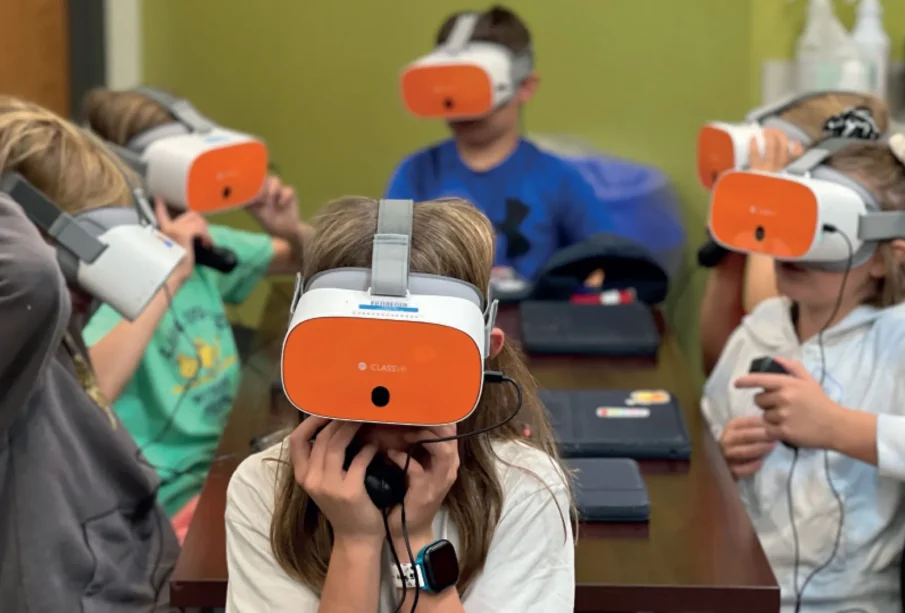
Introduction
Education has always evolved alongside technological innovation. From chalkboards to tablets, each advancement has changed how knowledge is delivered and absorbed. Virtual Reality (VR) is now emerging as one of the most transformative technologies in modern education.
Virtual Reality creates immersive digital environments that allow students to explore concepts, places, and simulations as if they were physically present. Instead of merely reading about historical events or scientific phenomena, learners can experience them interactively, making education more engaging, memorable, and effective.
As VR technology becomes more accessible and affordable, schools and universities around the world are exploring its potential to redefine the classroom experience.
What is Virtual Reality in Education?
Virtual Reality in education refers to the use of VR technology and immersive simulations to enhance teaching and learning processes.
With VR headsets and specialized software, students can enter three-dimensional virtual environments where they interact with objects, scenarios, and lessons in real time.
Key Components of VR Learning
- VR Headsets – Devices that display immersive 3D environments.
- Controllers or Hand Tracking – Tools that allow students to interact with virtual objects.
- Educational VR Software – Applications designed for learning activities and simulations.
- 360-degree Content – Videos or experiences that provide a fully immersive perspective.
These components work together to create experiential learning environments that go far beyond traditional teaching methods.
How Virtual Reality is Used in Education
Virtual Reality is being applied across multiple educational fields, offering students opportunities to explore and practice in ways that were previously impossible.
1. Virtual Field Trips
VR allows students to visit places they might never see in real life.
Examples include:
- Exploring ancient civilizations
- Touring space stations or planets
- Visiting world museums and historical landmarks
- Observing marine ecosystems underwater
These experiences help students develop a deeper understanding of geography, history, and culture.
2. Science and Laboratory Simulations
Many schools lack access to expensive laboratory equipment. VR provides a safe and affordable alternative.
Students can:
- Conduct virtual chemistry experiments
- Study human anatomy in 3D
- Explore molecular structures
- Practice engineering designs
This reduces risks while allowing unlimited practice.
3. Medical Training
Medical education has embraced VR to train students in realistic clinical scenarios.
Medical students can:
- Perform virtual surgeries
- Practice diagnosing patients
- Learn emergency response techniques
- Simulate complex medical procedures
This immersive practice improves skills before working with real patients.
4. Language Learning
VR environments help learners practice languages in realistic contexts.
Students can:
- Interact with virtual native speakers
- Navigate foreign cities
- Participate in simulated conversations
This helps build confidence, pronunciation, and cultural awareness.
5. Skill-Based and Vocational Training
VR is particularly effective in fields that require hands-on training.
Examples include:
- Aviation simulations for pilots
- Construction safety training
- Industrial machinery operation
- Military and defense simulations
Learners gain practical experience without real-world risks.
Benefits of Virtual Reality in Education
Virtual Reality offers several advantages that traditional teaching methods cannot easily match.
Immersive Learning Experience
VR places students directly inside the lesson, making learning more engaging and interactive.
Better Knowledge Retention
Research suggests that immersive experiences improve memory retention, because students learn through active participation rather than passive observation.
Safe Learning Environment
Students can practice dangerous or complex tasks safely, such as:
- Surgical procedures
- Chemical experiments
- Emergency response scenarios
Increased Accessibility
VR can provide access to environments that are otherwise difficult or impossible to reach, such as deep oceans, outer space, or historical reconstructions.
Personalized Learning
Educational VR platforms can adapt lessons based on individual student progress and performance, enabling more tailored learning experiences.
Challenges of Implementing VR in Education
Despite its benefits, VR adoption in education also faces several challenges.
High Initial Costs
VR equipment, software development, and maintenance can be expensive for schools with limited budgets.
Technical Requirements
Effective VR learning requires:
- High-performance computers
- Reliable internet connectivity
- Technical support and maintenance
Teacher Training
Educators must learn how to integrate VR effectively into their teaching methods, which may require additional training and professional development.
Health and Safety Concerns
Extended VR use may cause:
- Eye strain
- Motion sickness
- Fatigue
Therefore, VR sessions should be carefully managed and limited in duration.
The Future of Virtual Reality in Education
The future of VR in education looks promising as technology continues to improve.
Several trends are likely to shape its growth:
- More affordable VR devices
- Cloud-based VR learning platforms
- Integration with Artificial Intelligence
- Collaborative virtual classrooms
- Remote immersive learning environments
In the coming years, students may attend fully interactive virtual campuses, where learning takes place in immersive digital worlds that blend physical and virtual education.
Conclusion
Virtual Reality is rapidly transforming the educational landscape by creating immersive, interactive, and experiential learning environments. By enabling students to explore complex concepts, distant locations, and realistic simulations, VR enhances understanding and engagement in ways that traditional methods often cannot achieve.
Although challenges such as cost and technical requirements still exist, ongoing technological advancements are making VR more accessible. As adoption continues to grow, Virtual Reality has the potential to revolutionize education and reshape how future generations learn.
Frequently Asked Questions (FAQs)
1. What is the main purpose of Virtual Reality in education?
The primary purpose of VR in education is to create immersive learning experiences that allow students to interact with digital environments, improving understanding and engagement.
2. Is Virtual Reality suitable for all educational levels?
Yes. VR can be used across primary schools, secondary schools, universities, and professional training programs, depending on the complexity of the content.
3. Do students need expensive equipment to use VR in education?
Not always. While advanced VR headsets provide the best experience, some educational platforms also support mobile VR or simplified immersive technologies.
4. How does VR improve student engagement?
VR transforms passive learning into active participation, allowing students to explore, experiment, and interact with educational content.
5. Can Virtual Reality replace traditional classrooms?
VR is unlikely to replace classrooms entirely. Instead, it will complement traditional teaching methods by adding immersive experiences to existing learning systems.
6. What subjects benefit the most from VR learning?
Subjects such as science, medicine, history, engineering, and geography benefit significantly because VR allows students to visualize and interact with complex concepts.
7. Is Virtual Reality safe for students?
Yes, when used responsibly. Educators should ensure appropriate session lengths, proper supervision, and safe VR equipment usage to avoid discomfort or fatigue.